US-Iran Ceasefire Over: Trump’s Stunning Warning


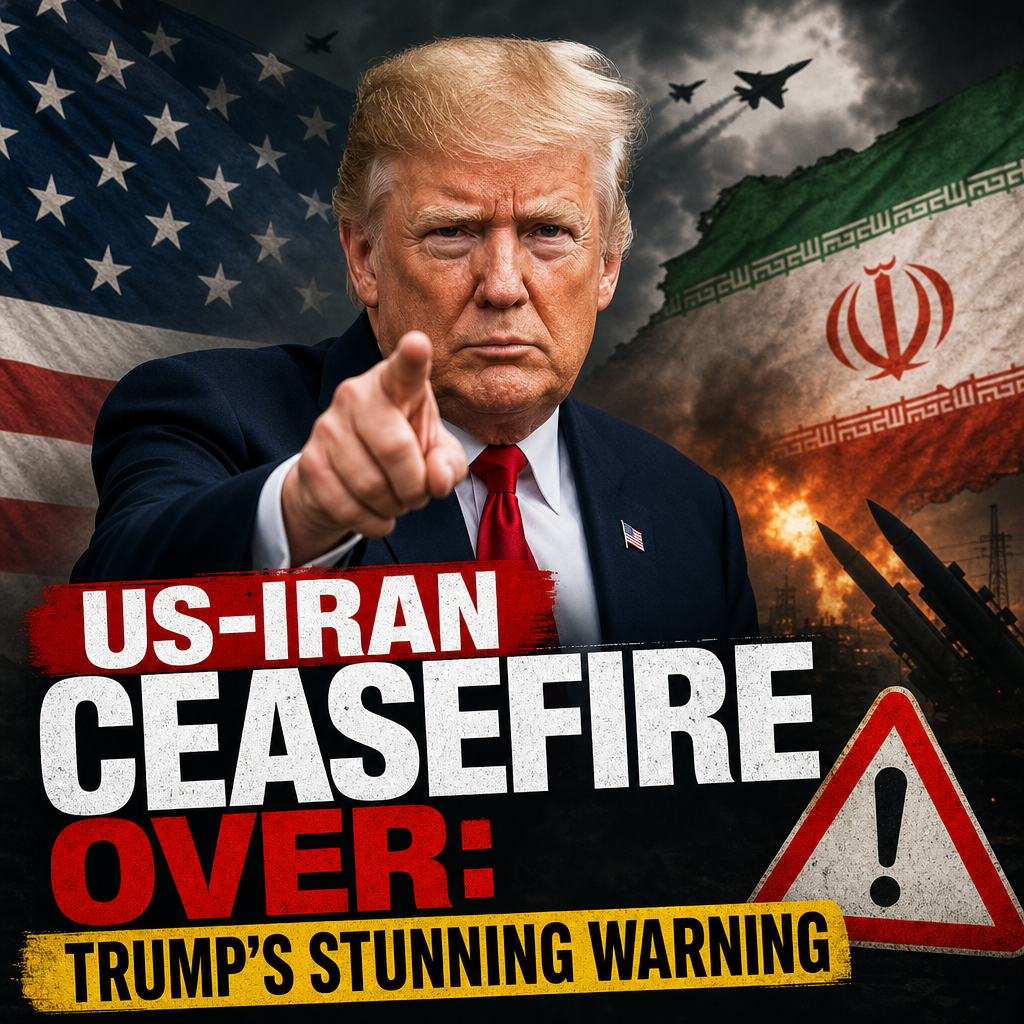
US-Iran ceasefire talks have been thrown into fresh doubt after Donald Trump issued a warning that sounds less like diplomacy and more like a signal that tensions could quickly snap back into open confrontation.
At the heart of the latest alarm is a simple but dangerous reality: even when the shooting pauses, the underlying conflict does not disappear. Across reporting from multiple international outlets, the message is consistent, even if the interpretation differs. The truce may be holding on paper, but mistrust, military pressure, and political calculation are all pulling in opposite directions.



A fragile pause, not a lasting peace
What makes this moment so unstable is that ceasefires between the US and Iran are rarely straightforward. In practice, they often sit inside a wider regional contest involving proxies, military deterrence, and domestic politics on both sides. A warning from Trump — especially one delivered in dramatic terms — can therefore have consequences well beyond the immediate headline.
From one angle, the former president’s comments can be read as a deterrent move: a way to remind Tehran that the US still has the capacity and willingness to respond forcefully if provoked. Supporters of this approach argue that Iran only backs down when confronted with credible pressure, not with soft language or open-ended diplomacy.




But critics see something else entirely. They argue that blunt public warnings risk turning a fragile ceasefire into a political weapon. If each side starts interpreting statements as threats, a pause in hostilities can become a countdown to the next escalation. In that sense, even “tough talk” can make a ceasefire weaker, not stronger.
That tension came through clearly in the way different outlets framed the story. Some coverage leaned into the drama of Trump’s remarks and the possibility that the ceasefire is already effectively over. Others focused on the broader strategic context, stressing that neither Washington nor Tehran appears eager for a full-scale war, even if both are trying to preserve leverage.
What the different media angles reveal
The reports from RT, Al Jazeera, and Sky News do not tell identical stories, but taken together they highlight three distinct viewpoints:
– Pressure-first view: Trump’s warning is seen as a deliberate show of force meant to deter Iran and reassure allies that the US will not tolerate provocation.
– De-escalation view: The ceasefire is still the best available option, and inflammatory rhetoric could undermine fragile backchannel efforts or encourage hardliners on all sides.
– Regional-risk view: The most immediate danger may not be a direct US-Iran war, but a wider chain reaction involving Israel, militias, shipping lanes, and allied states.
That mix of perspectives matters because the conflict is not happening in a vacuum. Each statement from Washington or Tehran can affect markets, military readiness, diplomatic contacts, and civilian fears across the region.
US-Iran ceasefire: why Trump’s warning matters now
If the ceasefire is “over,” as some headlines suggest, the deeper question is whether it was ever truly stable in the first place. The answer, based on the pattern of recent crises, is probably no. These pauses often reflect exhaustion, strategic caution, or outside pressure rather than genuine trust.
Trump’s warning matters because it changes expectations. When a high-profile figure signals that restraint may be ending, commanders, diplomats, and allied governments all begin planning for the worst. That can produce a self-fulfilling cycle: more alerts, more military posture, and less room for compromise.
There is also a political dimension. Trump’s language tends to be aimed not only at Iran but also at his domestic audience. A hardline stance can project strength, reinforce his brand, and appeal to voters who believe America has been too cautious in the Middle East. At the same time, it can limit diplomatic flexibility. Once a leader publicly draws a red line, backing away becomes harder.
Iran, for its part, is likely to respond by framing any US warning as evidence that Washington cannot be trusted. That message tends to resonate internally and across the region, especially among those who argue that only deterrence — not negotiation — can protect Iranian interests.
The bigger risk is miscalculation
The most worrying scenario is not necessarily a planned war. It is an accident, an overreaction, or a misread signal.
A ceasefire can collapse for all sorts of reasons:
– a strike that was meant as a warning but causes casualties
– a militia attack that one side blames on the other
– a naval incident in a contested waterway
– a public statement that narrows the space for quiet diplomacy
This is why language matters so much. A warning designed to project strength can also shrink the room for face-saving compromise. And when both sides are watching for weakness, even a small incident can be interpreted as proof that the other side is acting in bad faith.
A cautious conclusion
So is the US-Iran ceasefire really over? Based on the broader picture, the most honest answer is that the ceasefire looks highly unstable, but not necessarily dead. The fighting may have paused, but the confrontation has not been resolved. Trump’s warning raises the stakes, and perhaps intentionally so. Yet history suggests that when rhetoric outruns diplomacy, the region becomes more volatile, not less.
For now, the balance appears to be between deterrence and escalation. If cooler heads prevail, the warning could function as pressure without immediate conflict. If not, it may be remembered as one more moment when a tense standoff moved a step closer to open crisis.
What is clear is that neither side appears to trust the other, and in that environment, even a ceasefire is only as strong as the next decision.